
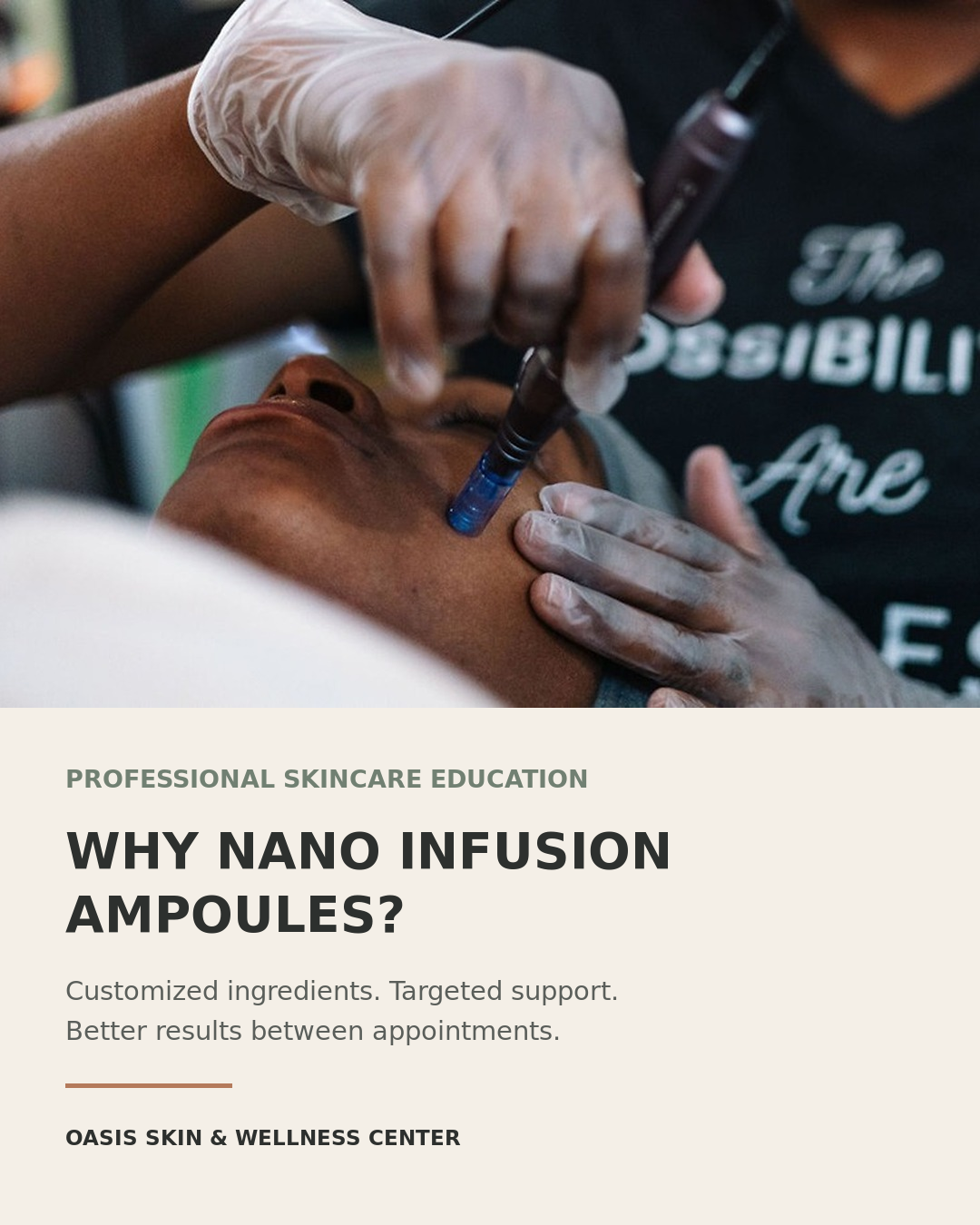
How Professional Ampoule Infusions Support Aging Skin
A good home-care routine is the foundation of healthy skin. However, there are times when aging, pigmentation, dehydration, and slower cellular renewal require more targeted support than daily skincare can provide on its own.
That is where professional treatments such as an ampoule infusion facial can help.
At Oasis Skin & Wellness Center in Murphysboro, Illinois, ampoule infusions allow us to pair a nano infusion tool with concentrated, professionally selected ingredients. Rather than applying the same serum to every client, the infusion can be customized according to the skin’s current condition and stage of aging.
Ingredients such as retinaldehyde, epidermal growth factor, tranexamic acid, and PDRN each provide a different type of support. The goal is not simply to make the skin glow for a few days. It is to help improve the environment in which the skin renews, repairs, hydrates, and protects itself.
What Is a Nano Ampoule Infusion?
A nano infusion treatment uses a cosmetic nano-tip to create temporary pathways within the skin’s outermost layer. This helps distribute the selected ingredients more evenly and enhances their contact with the epidermis.
It is important to understand what nano infusion does—and what it does not do.
Nano infusion is not an injection, and it should not be confused with medical microneedling or deeper Microchanneling. It works primarily within the superficial layers of the skin and generally does not produce significant inflammation or downtime.
During an Oasis ampoule infusion, the treatment may include:
Professional cleansing and skin preparation
Carefully selected exfoliation
Nano infusion using a customized serum
A targeted ampoule chosen for the client’s concerns
Hydrating and barrier-supportive finishing products
Broad-spectrum sunscreen
This creates an opportunity to deliver a more concentrated, customized treatment than a client would typically perform at home.
Why Professional Delivery Matters
Applying more product does not automatically create better results. Skin must be properly prepared, and the ingredients must be appropriate for its condition.
A professional infusion allows me to consider:
The client’s current stage of aging
Barrier strength and sensitivity
Pigmentation and melasma tendencies
Inflammation
Hydration levels
Previous treatment history
Current home-care products
Seasonal sun exposure
How quickly the skin is likely to recover
This is especially important as the skin ages. Younger, resilient skin may respond well to active renewal, while thinner or depleted skin may need more hydration, barrier support, and regenerative signaling. Giving every client the strongest possible treatment is not age management—it is just picking a fight with the skin.
Retinaldehyde: Supporting Slower Cellular Renewal
As skin metabolism begins slowing, epidermal cells take longer to form, mature, and shed. Older surface cells can accumulate, making the complexion appear rough, dry, or dull.
Retinaldehyde is an advanced form of vitamin A that supports healthy cellular renewal. It can help improve the appearance of:
Dull or rough texture
Fine lines
Sun damage
Uneven pigmentation
Enlarged pores
Loss of clarity
A professional retinaldehyde infusion introduces a concentrated formula during a treatment in which the skin has already been properly prepared. This allows the ingredient to be used more strategically than simply applying an additional layer of vitamin A at home.
Retinaldehyde is especially useful during the earlier metabolic stages of aging, when cellular renewal is beginning to slow but the skin still has a healthy capacity for repair.
It may also benefit more mature skin, but the treatment must be balanced with hydration and barrier support. Mature skin does not always need more exfoliation—it often needs better-organized renewal.
Epidermal Growth Factor: Supporting Cellular Communication
Our cells communicate through chemical messengers. Growth factors are part of this signaling system and help coordinate processes involved in renewal and repair.
As skin ages, cellular communication can become less efficient. Fibroblasts also become less responsive and produce smaller amounts of collagen, elastin, hyaluronic acid, and other materials that support the dermis.
Epidermal growth factor, or EGF, is used in professional skincare to support the appearance of healthier renewal and recovery. Topical EGF formulations have been studied for improvements in visible texture, pigmentation, pore appearance, and wrinkles, although results depend on the formulation and delivery system. Research on EGF in dermatological skincare supports its potential role in aging and damaged skin.
EGF may be particularly helpful for skin experiencing:
Slower recovery
Fine lines
Rough or uneven texture
Early loss of firmness
Dullness
Signs of environmental damage
Think of EGF as a supportive message. It does not build collagen itself, but it can help support the communication involved in healthy skin function.
Tranexamic Acid: Supporting Uneven Pigmentation
Pigmentation becomes more difficult to manage when inflammation, hormones, heat, and ultraviolet exposure repeatedly stimulate melanocytes.
Tranexamic acid helps interrupt some of the signaling pathways involved in excess pigment production. It is commonly used to improve the appearance of:
Melasma
Post-inflammatory pigmentation
Uneven skin tone
Sun-related discoloration
Pigment left behind after breakouts
Topical tranexamic acid has shown promising results for melasma and other pigmentation concerns, including in skin tones that are more vulnerable to post-inflammatory discoloration. Clinical research on topical tranexamic acid suggests that it can be a useful non-hydroquinone option when incorporated into an appropriate treatment plan.
During an ampoule infusion, tranexamic acid can be selected when pigmentation—not necessarily wrinkles—is the most visible sign of accelerated aging.
It is important to remember that tranexamic acid helps manage pigment signaling; it does not make the skin immune to the sun. Daily sunscreen remains essential, particularly for melasma-prone clients.
PDRN: Supporting Recovery and Resilience
PDRN stands for polydeoxyribonucleotide. It is composed of purified DNA fragments, commonly derived from salmon, and has a history of use in regenerative and wound-healing research.
PDRN is being explored in professional skincare for its potential to support:
Skin recovery
Barrier function
Hydration
Inflammation management
Texture
Overall resilience
PDRN may be particularly valuable for skin that no longer recovers as quickly as it once did or after a professionally selected peel or corrective treatment.
Research into PDRN and related polynucleotides is promising, but much of the strongest evidence comes from medical, injectable, or wound-healing applications rather than cosmetic topical ampoules. For that reason, I view topical PDRN as a supportive ingredient—not a miracle replacement for lost collagen or an injectable treatment in a tiny bottle. Current research on polynucleotides in aesthetic medicine continues to explore their effects on skin quality and rejuvenation.
Matching the Ampoule to the Skin’s Stage
Professional treatments should be selected according to how the skin is functioning—not simply the client’s age.
Early Metabolic Slowdown
The skin may appear dull, dehydrated, or uneven while still recovering relatively well.
Helpful professional support may include:
Retinaldehyde for renewal and texture
EGF for cellular communication
Hydrating ingredients to reinforce the barrier
Antioxidants and daily sunscreen
The goal at this stage is to maintain healthy function before more significant depletion occurs.
Pigment-Dominant Aging
For some clients—especially those with melasma or deeper skin tones—uneven pigmentation may appear before pronounced wrinkles.
Helpful support may include:
Tranexamic acid
Retinaldehyde when appropriate
Gentle, controlled exfoliation
Anti-inflammatory home care
Daily broad-spectrum sunscreen
The goal is to reduce unnecessary pigment signaling without creating additional irritation that could make discoloration worse.
Reduced Repair and Structural Change
At this stage, clients may notice more persistent lines, roughness, crepey texture, slower healing, or loss of firmness.
Helpful support may include:
EGF to support cellular communication
PDRN to support recovery and resilience
Retinaldehyde to maintain organized renewal
Peptides, antioxidants, and lipid-rich moisturizers
Professional treatments performed in a planned series
The goal is to stimulate without overwhelming skin that has fewer resources available for recovery.
Mature, Depleted, or Reactive Skin
More mature skin may be thin, dry, easily irritated, or slow to recover.
Helpful support may include:
Gentle EGF or PDRN infusions
Intensive hydration
Barrier-supportive lipids
Carefully scheduled retinaldehyde
Longer recovery periods between corrective services
At this stage, restoring comfort and function may be more beneficial than repeatedly forcing exfoliation.
Why One Treatment Is Not the Whole Plan
A professional infusion gives the skin a concentrated period of support, but it cannot compensate for inconsistent home care.
Your skin continues facing dehydration, inflammation, pollution, and ultraviolet exposure every day after you leave the treatment room. Home care helps protect the progress made during your service and keeps the skin supported between appointments.
A well-designed routine may include:
A gentle cleanser that does not strip the barrier
A vitamin A product such as Correct MD to support renewal
Affirm MD to support the appearance of firmness and elasticity
Hydrating and barrier-supportive products
Targeted pigment or antioxidant support
Broad-spectrum SPF 30 or higher every morning
Professional services create focused stimulation. Home care provides daily consistency. You need both if you want changes that last.
It is similar to working with a personal trainer: the appointment can provide expert direction and a stronger workout, but what happens during the rest of the week still matters.
Sunscreen Protects the Investment
Sunscreen deserves special attention because ultraviolet radiation accelerates nearly every concern we are trying to improve.
UV exposure contributes to:
Collagen breakdown
Abnormal elastin accumulation
Oxidative stress
Inflammation
Uneven pigmentation
Slower recovery
Premature lines and wrinkles
Daily broad-spectrum sunscreen helps prevent new external damage while professional treatments and home care address existing concerns.
Here in Southern Illinois, sun exposure does not only happen at the lake or pool. It happens while driving through Murphysboro, Carbondale, Marion, and Anna, working near a window, attending an outdoor event, or doing yardwork on a cloudy afternoon.
If we are investing time and money into correcting pigmentation and supporting collagen, skipping sunscreen is like mopping the floor while the sink is still overflowing.
Professional Treatments and Home Care Work Together
Professional ampoule infusions can provide more concentrated and customized support than home care alone. Home care then maintains that support by consistently protecting the barrier, encouraging healthy renewal, managing pigmentation, and limiting new environmental damage.
Neither one replaces the other.
At Oasis Skin & Wellness Center, every nano infusion facial in Murphysboro, Illinois, is selected according to the client’s skin—not a one-size-fits-all protocol. Retinaldehyde, EGF, tranexamic acid, and PDRN each have a different role, and the best ingredient depends on what your skin is experiencing now.
The goal is not to use every active ingredient at once. It is to give the skin the right support, in the right amount, at the right stage.
Schedule an Age Management Facial and skin consultation at Oasis Skin & Wellness Center to discover which professional infusion and home-care plan best support your skin today.
